Wednesday, October 17, 2012

UFOs and Stalactites

October 17, 2012
We visited Carlsbad Cavern National Park today.  Wow!  For those that have seen it, you know why it's a WOW.  This is not your run of the mill cave.  The Big Room can hold 14 football fields and is a mile and 1/2 around.  There are stalactite, stalagmite, popcorn, and drapery formations of all shapes, sizes, and colors. The photos included don't come close to displaying the beauty.  A big surprise to us was that it's underground by 750 feet and you ride up and down in an elevator, although there is a walk in entrance we are taking tomorrow.  Once down there, you'll find bathrooms, real ones not porta-potties; a lunch/snack bar; and a gift store.  Its like a city down there.  The paths are paved and in most areas of the Big Room, wheelchair accessible.

The cave was discovered in the 1890s by James Larkin White ( a 16 year old), and became a National Park in 1930. It is named after the city of Carlsbad, NM.  Carlsbad was named for its mineral springs after the German town of Karlsbad.  The Caverns became of commercial importance for the collection of Guano, bat poop, which is supposedly an excellent fertilizer.   They extracted 100,000 tons of the stuff, until the Park Service shut it down.  Now folks, that's a forty foot deep pile; 100s of yards across.  So, as you might surmize they have lots of bats here, but they tend to follow the bugs and have gone elsewhere for the winter. 

The lighting in the cave is spectacular.  It was setup by theatrical lighting experts in the 70s, to accentuate the formations.  It does an awesome job and setting this up had to have been a really big deal.  They are preparing to redo it using LEDs which are more energy efficient and does not promote additional heat and algae.  They figure 3-5 years to complete.

We're going back tomorrow to take a lantern hike and to hike in from the Natural Entrance, no elevator.  We are also going back to the Big Room with a tripod to get better pixs.


October 16, 2012
What would a stop in New Mexico be without visiting Roswell?  This little town got it's notoriety from an incident in 1947, where allegedly a Flying Saucer with Aliens crashed during a big thunderstorm.  In town is the International UFO Museum and Research Center where they give you the true story.  It describes the government's coverup in detail.  It will make you a believer.  Now it is time to point out that this balances the PIMA Air Museum, as this was Lynn's stop, as shown in the picture.  However Dan found it interesting also.

Tuesday, October 16, 2012

From Cowboys to White Sand

October 15, 2012
This area is known for its white sand dunes, present in the White Sands National Monument.  This park encompasses about 80% of the white sands area.  The sand is pure white and powdery as sugar.  You maybe accustomed to the silica type sand and dunes that are off white, and found along shorelines.  This stuff is different.  It is gypsum, yep the same stuff that's in drywall.  Chemically its hydrous calcium sulfate, formed from dissolution of the surrounding mountains from rain and snow.  This runoff collects in the Tularosa Basin and forms lakes that dry up.  Everywhere else this runoff would go into the sea, but here it is trapped and evaporates.

Crystals of selenite form, which are very fragile and breakdown into very fine particles by the strong winds present during the summer monsoon.  This wind movement also creates the dunes, which are said to be moving southwest to northeast at a rate of up to 35 feet per year in some areas.  The true story though is how plants and animals have adapted to live here, from fast growing soaptree yucca, to the white earless lizards.  More than once though for us northerners, we caught ourselves expecting it to be cold when we jumped out of the truck.  It looks just like snow and the plow they use on the park road to keep it open creates the same plow furloughs.  Check out the views.
Gypsum crystals


October 14, 2012
This was a travel day as we made our way toward Alamogordo, Spanish for Big Cottonwood, due to three huge cottonwood trees that lived by the local spring.  Strange to us, we have now encountered two Border Patrol checkpoints, asking our citizenship in our travels.  You pass through several cameras upon entering these checkpoints.  The scenery is quite pretty, but there are the climbs as you make your way over some of the mountains.  The truck handled these with little problem, maintaining 45-50 mph, but at 8 to 9 mpg.  We have been experimenting with the gas, since regular is 86 octane.  It seems to work fine no knocking and fuel economy is the same as with 88 octane mid-grade.

October 13, 2012
Today we visited Tombstone, AZ, about an 1 ½ hour drive from Tucson.  The town is actually an Old West museum.  Of course it is most known for the shootout at the OK Corral between the Earp brothers, the McLowerys, and the Clantons, which we’ll get to momentarily.  Tombstone however  really began as a mining town after Ed Schieffelin discovered silver in 1877.  All the gunfights and typical old west type stuff were actually pretty common in mining towns.  Setting Tombstone apart were a band of cowboys that rustled cattle, robbed stagecoaches, and generally caused problems with the residents of Tombstone.

In the 1880s Tombstone was in its heyday, 15,000 residents and a booming economy.  They bounced back from two fires that destroyed the town, but when the pumps failed and the mines flooded that was pretty much the end of it.  We toured one of Schieffelin’s mines, down to 400 feet or so, as the rest is still underwater.  This is an underground hard rock mine.  They drilled the holes for dynamite by hand using hammer and star bits, by candlelight!  We can only imagine how many hands were broken in this process.  When he finally sold the mine, Schieffelin had earned $300,000 in 1890’s dollars.  Yield ran as high as 1400 ounces of silver per ton.  Schieffelin staked his claim, calling it Tombstone, since he was told he would have a tombstone before he found any silver.  Thus the town became known by that name.
 
Drilling holes for dynamite
Now onto the big gunfight, which lasted all of 30 seconds, however the build up was going on for weeks. Mainly it was between the Clantons and Doc Holiday.  Holiday started the thing going when he shot Billy Clanton.  Ironically, the McLowery’s were leaving town and were at the OK Corral to settle a debt.  They were armed which was against the law at the time in Tombstone.  As you know, Frank and Tom McLowery and Billy Clanton were killed. Virgil and Morgan were wounded.  Ike Clanton, Holiday’s nemesis got away as he was unarmed. Did you know that Doc was a dentist, but he was better known as a gambler and drunk? 

There was an inquest but without a decision. Virgil was later badly wounded and lost use of his left arm.  Morgan was killed.  After that,Wyatt went off the deep end and led a vendetta to kill all the cowboys; high on the list were the men that killed Morgan.  The town does a good job of preserving this history, although few of the buildings are original.  The OK Corral re-enactment was a bit of a disappointment.  There was no gun smoke and the guns sounded like toys.  Visiting Tombstone was really like a day back in time.

Tombstone Residents

Allen St, the main street of Tombstone
October 12, 2012
Today’s adventure took us to the Pima County Air & Space Museum.  Looking at a bunch of old airplanes is not Lynn’s idea of a day in paradise, but she did find parts of it interesting.  Dan took the tour to the “Boneyard”, actually the Davis Monthon A.F.B. (Aerospace Maintenance And Regeneration Group) where military aircraft removed from service are brought for storage or scrap.  There were 4,400 aircraft on site.  Many planes date back to the Korean War.  The U.S. has sold many surplus aircraft to other countries. When a part is needed that cannot be made, they place an order and the part is cannibalized from one of these planes.

Between the two locations is an amazing collection of old, and not so old, aircraft.  Pima has done a remarkable job in restoring the aircraft they have on display.  Dan is somewhat an aircraft aficionado, as the design and size of these machines is a fascination.  The following are pictures of a few.

Planes being parted out

F14A "Top Gun"

Friday, October 12, 2012

The Old West and Cactus

October 11, 2012

We arrived in Tucson today after a short drive from Mesa and spent the afternoon visiting the Sonoran Desert Museum and Saguaro National Park. Our campground, Desert Trails is mostly deserted, which is a welcome relief from the hustle and bustle of campgrounds from previous nights.  The Desert Museum is actually a combination of botanical garden and zoo, although the garden is not as well maintained as the one we went to yesterday in Phoenix.  It is a more "natural" setting and the specimens exhibited are just those that have grown up in the park.  The zoo portion has animals native to the area. There were some unique animals that we haven't seen before, like a coati, that is related to the racoon. It had a long tale and  a much longer nose than a racoon.  I could not get a picture as it stayed back in some brush.

The hummingbird aviary was pretty neat.  We were surprised to see so many varieties of hummingbirds.  We were a bit disappointed that more animals were not visible, but that is typical for a zoo. Nearing dusk we headed into Saguaro NP.  Saguaro cactus are quite unusual.  The arms you see form after the plant is 50-75 years old.  Many Saguaros in the Park are 125 to 150 years old.  Every spring when they reach an age of about 25 they bear a fruit that is harvested by the Tohyonr O'odham Indians for making jams, syrups and wine.  Birds peck holes in the outer skin to build nests.  As we learned yesterday, the inner wooden core is often used by Indians for building materials.

Saguaro National Park needs some love from the NPS.  Trails are a bit rough and unimproved,  There is a 5 mile dirt and bumpy loop road that takes you though stands of Saguaro,  To us, the park is a forest, except instead of trees it's Saguaro cacti. 


October 10, 2011

Today we visited the Desert Botanical Garden near Phoenix  This place is awesome.  We had no idea there were so many different species of cactus.  The cactus is an amazing plant.  They all have a wood-like inner structure for support, and a large, shallow root system for collecting minute volumes of water.  A falicy is that in the desert, one can slice a cactus and get water. The water is stored in a pulpy material that holds the moisture, but it really is not edible.  The pleat pattern you see is to allow for expansion to store water and contract as the water is consumed.   Most bloom then form a fruit often used in jams and syrups.  The needles on a cactus are for protection, and I would say after closer examination, are effective.


Within the Garden was a Monarch Butterfly garden, kinda of an aviary for butterflies.  This area is on the migratory route.

October 9, 2012

We spent the day with our friend, by going to the Goldfield Ghost Town and Museum near Superstition Mountain.  This area of Arizona experienced a gold rush in 1880s with this mine producing several thousand pounds of gold.  The mine in this location was abandoned in the 1890s, and as typical they just left, leaving all their junk behind.  There are original buildings and equipment, and also some buildings from Apache Land, a movie set used up until the 1990s for Hollywood and TV westerns.  Overall, an interesting place.


October 7-8, 2012

Its Sunday, what better day to visit Las Vegas.  Afterall no one should be in the City of Sin on the Sabboth, right?  Wrong!  This place was booming with people everwhere.  We hit the Pawn Stars shop first thing before the Strip got too choked with cars.  Its just like the show, but no Rick Chumlee, or the Old Man.  History films there every weekday for 1/2 hour between 9 and 3PM.

We then parked in the MGM Grand garage and walked part of the Strip up to Bellagio.  All we can say is wow.  This is excess to the max!  The shops, like those at Ceasar's, called the Shops at the Forum.  Stores like Tiffanies, Gucci, Rolex, and Coach; and people were buying stuff.  Maybe their gambling experience was profitable.  Fountains and manmade lakes were everywhere, water shortage?  These guys did not get the memo. This sure was not the Las Vegas we remembered from the 70s.  We walked, about 4 miles up, then back to MGM before heading home.  We decided we have now had our Las Vegas experience.


It's Monday and we are on our way to Mesa, AZ, to visit a friend and take in some sights there.  We are staying at Valle de Oro.  A resort park so big you need a map to avoid getting lost.  Plan on staying here a couple of days.

Saturday, October 6, 2012

By a Dam Site


October 6, 2012

Lake Mead

We are currently in Boulder City, NV, the town was created to house the workers employed to build the Hoover Dam.  The dam was built during the height of the Depression and employed 3500 men per day at a wage of $4 a day.  They worked 8 hours/day, 7 days a week with 2 days off; July 4th and Christmas.  If they didn’t show up for work on any of those 363 days, they were fired. As you might guess, working conditions were deplorable.  Over 700 documented deaths occurred, many more “undocumented” deaths also occurred.  There was always a line up of replacements, even a strike that stopped work briefly but didn’t change much.

Out of their $4, $1.60 was deducted for housing, transportation, and food.  Amazingly most still managed to get in trouble with the remaining $2.40.  In Boulder City, even today, there is no gambling and no casinos.  But there was booze, and they got drunk frequently.  The Dam made SW Nevada very prosperous during the Depression.

Getting into this place was quite an ordeal today.  Just like at the Arch, you must pass though metal detector screening, and your vehicle is subject to search before crossing the Dam.  I had to drop the tailgate and roll back the bed cover. As most know, they built a by-pass bridge for traffic following Hwy 93.  Completion got accelerated with 9-11, but was in planning since the 60s.  Prior to that, all traffic followed the 2 lane road over the Dam, with major traffic snarls.  Today with the Dam tourists (pun intended) traffic was terrible, we can’t imagine what it was like before the by-pass bridge.  They really need to take a page from Grand Canyon and Zion.  Setup a shuttle only system with a big parking lot on the Nevada side.

 
Our impression of this feat of man was somewhat below expectation.  We aren’t sure why, but as we reflect, it may be the extremely low water level.  The level is 50 feet below design level.  As you see in the pictures, the ideal water level should be at the top of the white area.  The spillway should be under water, but it is high and dry.  The Hoover Dam is only providing electricity during peak use.  Today, on the Nevada side, only 3 of 8 turbines were running.  The tour guide told us water is dropping 10 feet per year.  Another 50 foot drop and they will not be able to generate any electricity here.

Spillway
 An interesting fact is that making electricity is secondary to providing water to the three states served by this impoundment.  At 50 feet low, there is really a critical water supply issue here.  As I’m sure we will appreciate tomorrow, the extravagant use of water by Las Vegas makes this seem ridiculous.

Our second stop was the Nevada State Railroad Museum. Dan can’t seem to pass these up, and this was no exception.  We took a ride on a 1930s restored passenger train down a set of tracks used to bring materials to the Dam during construction.  It was pulled by a 1950s era locomotive obtained from the US Army Ordinance Depot.  It was actually a switch engine powered by a 6 cylinder Fairbanks-Morse engine. 
 
 
Additionally, the Museum had several other unique cars and locomotives both steam and diesel.  The conductors were part of the restoration team.  Dan chatted up oil for that F-M engine, which they have a hard time finding.  The oil companies do not seem to understand that these 60+ year old engines continue to live on.

Tomorrow’s plan is to go up to Las Vegas for the day. 

Thursday, October 4, 2012

The Ulitmate Abyss

October 2, 2012
 
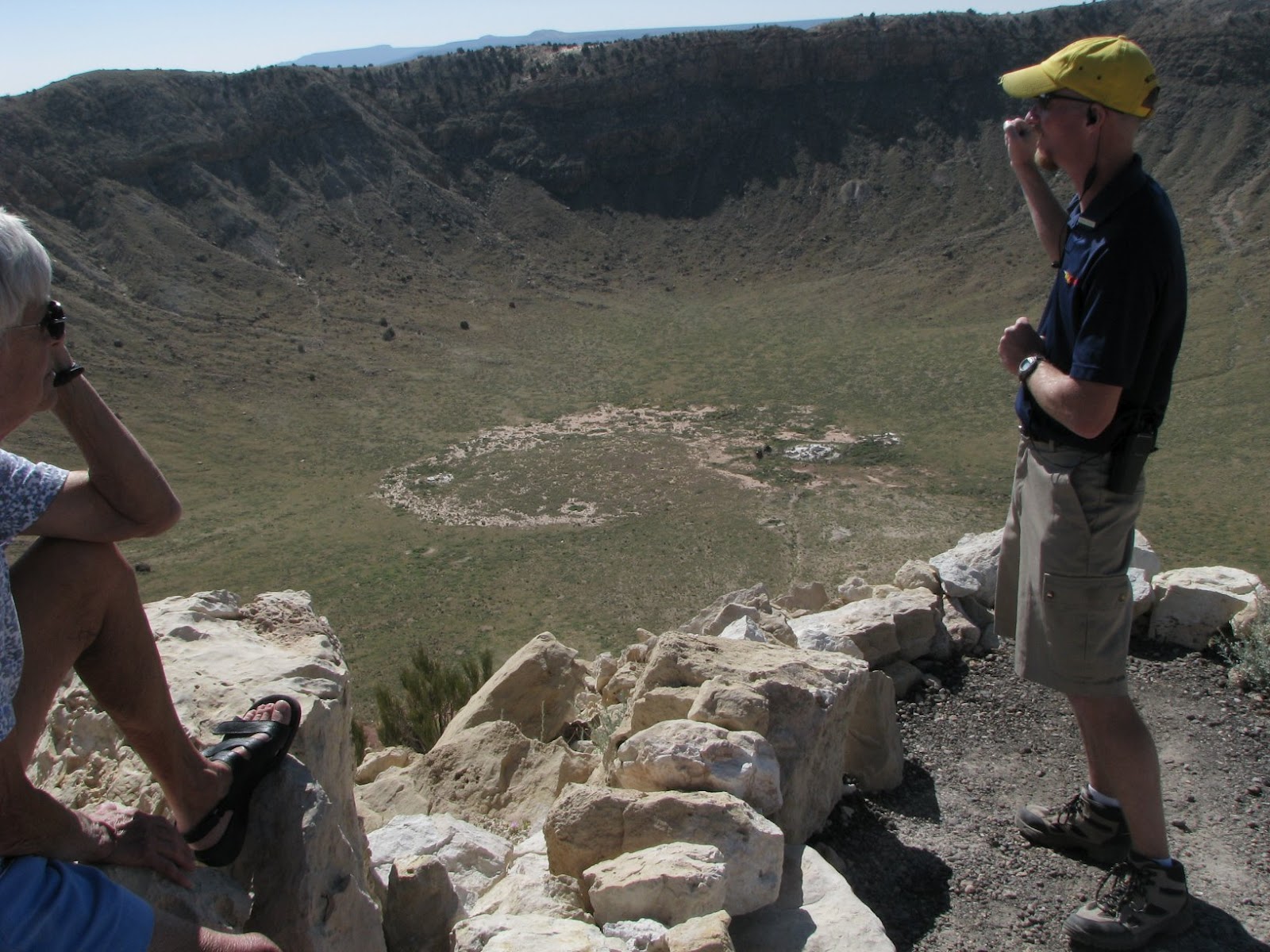
Today we traveled to the Grand Canyon, however we took a side trip.  Off I-40 were some signs about a meteor impact crater that you can stop and see.  It screamed “Tourist Trap”, but Dan talked Lynn into going there.  It was pretty interesting.  The story is that 50,000 years ago a meteor hit this spot and made a hole 700 feet deep and over 4000 feet across. The land and mineral rights were purchased by Daniel Barringer.  He thought this big hunk of iron lied at the bottom of the crater.  Seems logical, right?  After drilling all over the bottom of the crater, it was a bust.  No meteor, no iron, nothing; it blew up and vaporized on impact.  Since his death, his family set it up as a tourist attraction (trap).  NASA did use it to train astronauts on sampling moon rocks in the 60s. Actually it was pretty interesting.


We did finally make it to Trailer Village in the Grand Canyon Park.  Boy do we have the wildlife here!  Several elk come in morning and night to munch on acorns from the tree on our site, to the point it is sometimes problematic getting in and out of the trailer.


The park utilizes shuttle buses to help people get around the park and we can see why.  It is amazing to see all the people here.  Traffic and parking is nearly impossible.  If this is their slow season, we can only imagine what it would be like during peak season.  The buses are frequently full and require a wait for the next bus.  Although slow going, the bus system works quite well.  Not surprising, but you hear many different languages spoken, as this place is visited by many foreign travelers.

October 3, 2012
 
There are many overlooks of the canyon to see. Additionally, there is a ton of history and geology.  For those reading this, you know what we mean about the Grand Canyon being immense!  You just can’t take it all in.  Its over a mile deep and up to 18 miles across.  Each overlook has a different look, with the lighting angles and colors of the layers.  We picked a few to give you a taste.


The park history centers around the Grand Canyon Village.  People started coming to the Grand Canyon in the late 1880s by stagecoach. It was expensive to get here and the accommodations were really bad. Even way back then people wanted an “adventure”. The railroad and automobile really opened it up.  The Village finally got cleaned up in the 1920s.  Hotel rooms range from just under $200 to over $400 per night, so camping is the cheap way to stay here.

One tidbit we found interesting.  Two brothers, named Ellsworth and Emery Kolb made a business out of photographing the Grand Canyon.  Then they came up with an idea, photograph the Dudes as they begin their hike into the Caanyon, develop them, then sell the pictures to tourists when they return to the rim. Seems as though the Kolb brothers started a common sales gimmick still in use today. They also shot movies, mostly of people doing dumb things. The studio houses a small museum and gallery, and of course, a gift shop.


The next picture is from the "lobby" at Hermit's Hermit's Rest.  A waystation of sorts that allowed visitors in the Grand Canyon to come in and relax, while enjoying food and beverage.


October 4, 2012
 
Today is our last day here, so we decided to head toward the Desertview Watchtower at the eastern end of the park.  This is a must see in our opinion.  The views are actually much better here and not as crowded, although that is relative.  You see a much wider expanse of the canyon with more colors, and a better view of the Colorado River.  In fact, we both feel that if you are camping, and do not mind dry camping a couple of days, this is The part of the park to visit.  The Watchtower has all sorts of Indian paintings inside that you can look at as you ascend to the top.


Tomorrow we head to Boulder City to see the Hoover Dam and Las Vegas.  We have enjoyed our stay at the Grand Canyon, but are happy to be leaving it and the mob of people.  A tip we learned last year at the parks we visited.  Get an early start, before 8AM.  There are less people, better light for pictures, and cooler temperatures.

Monday, October 1, 2012

Rock on Wood

October 1, 2012

We really didn’t have anything big planned today, get groceries, get truck washed, stuff like that.  Well, we looked at some info about Holbrook and found it had quite an Old West past, complete with gunfights, etc.  In the 1886 there were 26 gunfight related deaths in a town of only 250.  So we went to a museum in the Courthouse to learn more. There is a street here named Bucket of Blood Ave, named after a gunfight in a saloon where 2 Mexicans were shot.  Someone said it looked like somebody spilled a bucket of blood; hence the name of the steet. The place got cleaned up after electing Sheriff Commodore Perry Owen.


Also Route 66 goes through town, actually it makes a turn, supposedly the only 90 degree turn in the whole route.  The cool thing though was the WigWam Hotel.  This is commonly shown in most any video about Route 66.  It is still open, and you can still rent a teepee for the night.


Wow 3 weeks on the road.  Time is flying by.   Tomorrow we leave for the Grand Canyon, doubt if we’ll find WiFi, so this may be the last post for a few days.  


September 30, 2012

Today we visited the Painted Desert and Petrified Forest National Parks.  These parks lie on either side of I-40, the Desert to the north, and the Forest to the south. Combined they are part of the Colorado Plateau formed millions of years ago.  The Painted Desert derived its name from the badland type mesas that show different colors of sediment within the up-croppings.  The Petrified Forest has more of these same mesas and colors, however it also contains areas where wood was buried in a tropical sea formed 225 million years ago.

The wood soaked up a high silica containing slurry.  Arizona at this time was near the equator.  As the continents shifted and the ocean receded, the silica and other minerals soaked into the wood, hardened (petrified) the wood.  All the wood and logs lie on their sides, although we have read there are stumps within the park, but are not visible in the public areas.  The “wood” became exposed as wind and water eroded the softer clay covering the wood, as well as small granite rocks once on the sea and river bottoms.

Petrified wood is about 80% as hard as diamond.  It is amazing in that it looks just like wood on the outside, but it’s actually stone.  The inside may have multiple colors depending on the minerals adsorbed.  Red, blue, purple, yellow; or it may just be brown like the original wood; depending on how porous the wood was when it sunk and what other minerals were present in the silica.

For years people have been removing “samples” from the park area, which was the driver for making it a National Park.  To the tune of tons per month!  They are serious about not taking it, as they question you as you leave, and may inspect your vehicle.  If caught, they will arrest you and fine you a minimum of $325.  In the long run, it is cheaper to buy the stuff, although it is tempting.

We have tried to select a few pictures to give you a flavor of these parks if you have never visited.  If you have, you know no pictures do it justice.  You just cannot capture this beauty in pictures.


Painted Desert

Petrified Forest


We haven’t talked much about the weather. Well it has been perfect, mid 80s in the daytime, and 50s at night.  We actually run a little heater in the morning to warm up the place a bit.  Our next stop is the Grand Canyon which is getting down into the mid 30s at night.  We may need that 2nd heater.  The rig has been working flawlessly, getting 9 to 11 mpg towing and 16 – 18 mpg running free.  It is really dirty though, our goal today is to find a car wash in Holbrook.

Sunday, September 30, 2012

Bouncing Along the Canyon Floor


September 28, 2012

We have been at Canyon de Chelly located near Chinle, AZ.  It is smack dab in Navajo Nation Territory.  The park is run by the Navajo, and the campground we are staying at is run by the Navajo Parks and Rec Dept.  Since many Navajo families inhabit the canyon area within the park, you are allowed to drive the north and south rims, but to go into the canyon you must have a Navajo guide.  Although it seems like a ploy to make some money, it is easy to understand why they do not want the public running wild down there.  I suspect they’d have people looking in windows, stealing souvenirs, and generally acting like A-holes.  Certainly the Navajo have withstood enough from us.

Canyon de Chelly is beautiful.  It is very much like the Grand Canyon, but on a much smaller scale.  Being smaller makes it easier to take it in and really see the detail.  We drove the rim routes but as we said last year, we should have taken a 4x4 tour in Canyonlands NP, we thought this would be the perfect place to do that, since we could not get in there on our own.  So we booked an all day trip in the canyon.

The following picture is our “limousine” we rode in all day.  You may recognize this thing, if you’re old enough.  It is government surplus from the Korean War.  Dan called it the “Hemorrhoid Express”.  There was zero give in the suspension, noisy, and dusty; and the cushions were 1 inch foam on steel plate seats.  To top it off, ours broke down about 3 hours into our trip.  Oh boy we’re sleeping in a cave tonight.  We wanted an adventure didn’t we?  Fortunately they brought in a replacement about an hour later, and we were on our way.  Well sort of, the universals were squealing.  Our guide bummed some oil off another passing truck.  I was dubious about the application of some 10W30 in the joints would work, but they quieted down and we made it back without incident.


Within the canyons were numerous petroglyphs, paintings, and Anasazi ruins.  Oh, and Navajo vendors hawking wares at almost every stop, which detracted from the natural ambience.  Despite that, it was still a beautiful trip and well worth the bouncing and dust.  It was hard to pick a few pictures of the canyon and they really don’t do it justice.


Our next stop is Holbrook, AZ where we plan to explore the Painted Desert / Petrified Forest National Parks.